

Iran has over $100 billion in frozen assets held across multiple countries: oil revenues, central bank reserves, funds locked in foreign banks from decades of US sanctions. It’s a stark lesson in what happens when you operate inside a financial system controlled by your adversaries.
But apparently, that lesson hasn’t fully landed. Because Iran has also been holding USDT, and Tether just froze $344 million of it.
Two kinds of stablecoins
The stablecoin market is now worth over $320 billion. USDT (Tether) alone commands 59% of that. Add USDC (Circle) and you’re looking at roughly 85% of the entire market in the hands of two centralized issuers.
Most people using these have no idea what “centralized” actually means in practice. Here’s what it means: Tether and Circle have a kill switch. Written directly into the smart contract. They can freeze your tokens in your wallet at any time, on any blockchain where that token exists.
USDT and USDC are not censorship-resistant assets. Circle is a US-regulated company, subject to US financial oversight. Tether is registered in the British Virgin Islands and is not subject to US regulation.
Yet both freeze accounts on US government instruction. That’s worth sitting with for a moment. A company with no legal obligation to comply with US authorities does so anyway. That tells you something about the reach of the system.
The chain matters. So does the asset.
The freeze on Iranian USDT happened on Tron, a centralized blockchain, which compounds the problem: centralized chain plus centralized asset equals zero protection.
But here’s what’s important to understand: even on a genuinely decentralized blockchain like Ethereum, a centralized asset can still be frozen. Decentralization of the network is not enough. You need decentralization at both levels, the chain and the asset you’re holding on it.
Most people in crypto don’t think about this. They assume that being on a decentralized blockchain means their assets are safe from interference. They’re not, if those assets are USDT or USDC.
The selective nature of freezing
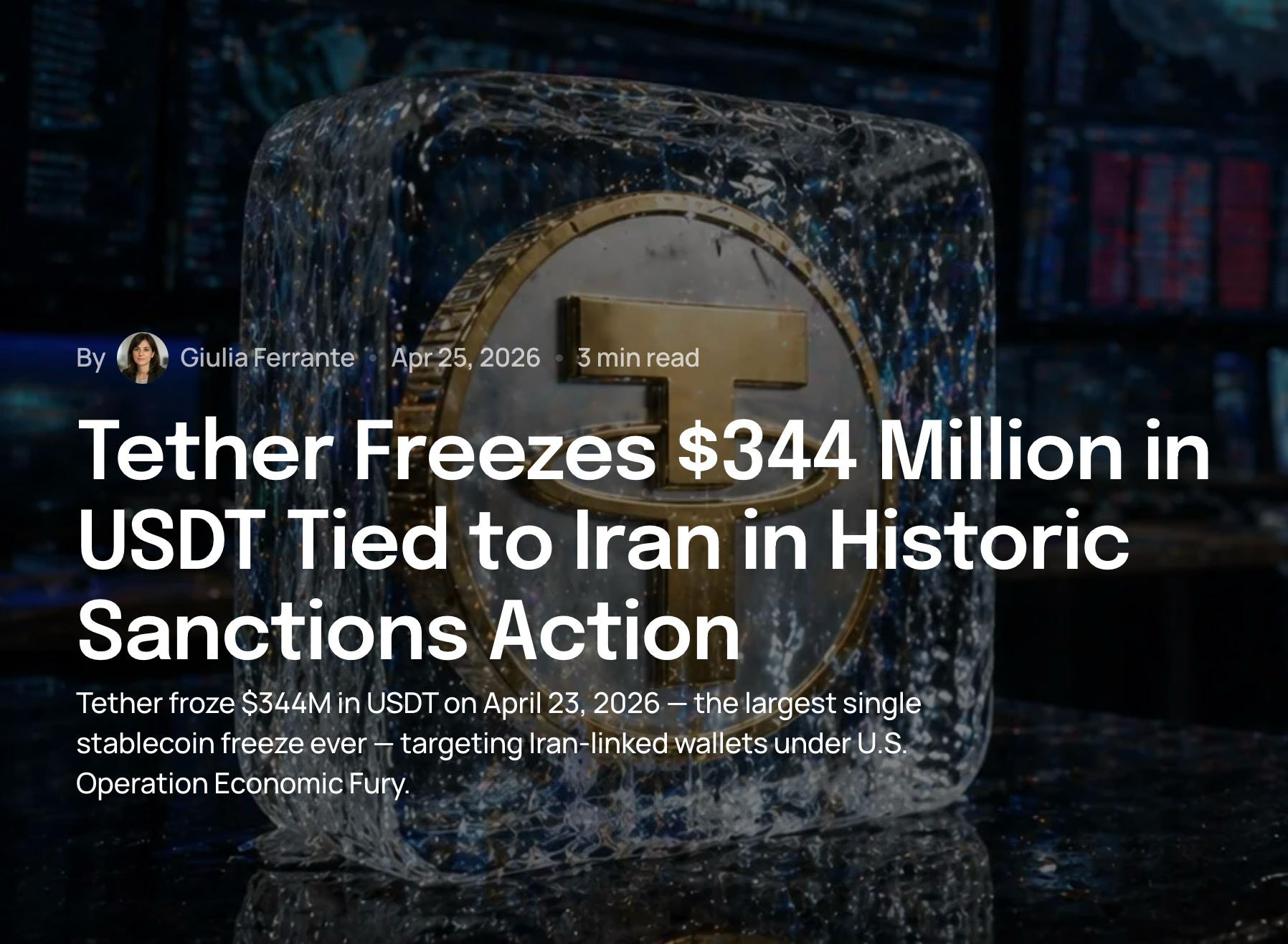
On April 23, 2026, Tether froze $344 million in USDT across two Tron wallets, the largest single stablecoin freeze in the company’s history, executed at the request of US authorities under Operation Economic Fury. US officials confirmed the wallets had material links to the Iranian regime, including transactions with Iranian exchanges and addresses connected to the Central Bank of Iran.
This is not a one-off. Tether has now frozen a cumulative $4.4 billion in assets, cooperating with over 340 agencies across 65 countries. Freezing accounts on government instruction is standard practice.
It is also selective practice. Iran, Russia, North Korea, Libya, Venezuela and Cuba have all had assets frozen by foreign governments. Israel, by contrast, despite facing repeated accusations of rights abuses and illegal wars, has had no overseas assets frozen by any country. The common thread is straightforward: it’s about who is and isn’t aligned with US interests.
Tether and USDC operate as instruments of this same system, one by legal obligation, one apparently by choice. If you’re comfortable with that, fine. But you should be clear-eyed about what you’re using.
The decentralized alternatives
There are stablecoins that cannot be frozen at the contract level. Liquity Protocol’s BOLD is a fully decentralized example, backed by ETH and decentralized ETH derivatives.
Curve’s crvUSD and Aave’s GHO are semi-decentralized: they can’t be frozen directly, but their collateral sometimes includes centralized assets like USDC or wBTC (a BTC derivative “wrapped” and put on the Ethereum network by a centralized custodian).
If a government wanted to attack semi-decentralized stablecoins, they’d have to freeze the collateral backing those assets, affecting every single user simultaneously, not just a targeted account. That’s a blunt, costly instrument. Much harder to use selectively.
The real problem with decentralized (and semi-decentralized) stablecoins isn’t the mechanism. It’s accessible liquidity at scale. Market cap and liquidity are not the same thing. Several decentralized stablecoins have billions in supply. But the relevant question is whether you can execute a $50M or $100M transaction with low slippage, on demand.
That depth exists for USDT and USDC. It doesn’t yet exist for the decentralized alternatives, where supply is dispersed across yield strategies, wallets and pools in ways that make large transactions slow and expensive. Until that changes, USDT and USDC will dominate for serious institutional use.
What about Bitcoin?
Some people’s response to all of this is: just use Bitcoin. That’s not a real answer. There are no stablecoins on Bitcoin. People want dollar-denominated stability on-chain for payments, for DeFi, for commerce. Bitcoin doesn’t solve that. What does solve it, over time, is building liquidity and trust in genuinely decentralized stablecoins.
What we’re actually building
If 85% of the stablecoin market can be frozen by two private companies acting on US government instruction, we haven’t built an alternative financial system. We’ve built a faster, cheaper version of the existing one, with the same censorship risks and the same selective enforcement baked in.
Decentralization is meaningless if the assets moving across decentralized networks are themselves centralized.
Iran made a mistake using USDT. But millions of ordinary users are making the same structural choice without even knowing it. Know what type of stablecoin you’re using. Know who controls the kill switch. And if that matters to you, support the protocols that are actually building the alternative.